We live in an era where almost every piece of knowledge exists somewhere on the internet.
University lectures, technical documentation, research papers, tutorials, blogs, and online courses — in theory, we have access to more learning resources than any generation before us.
Yet many people share the same experience:
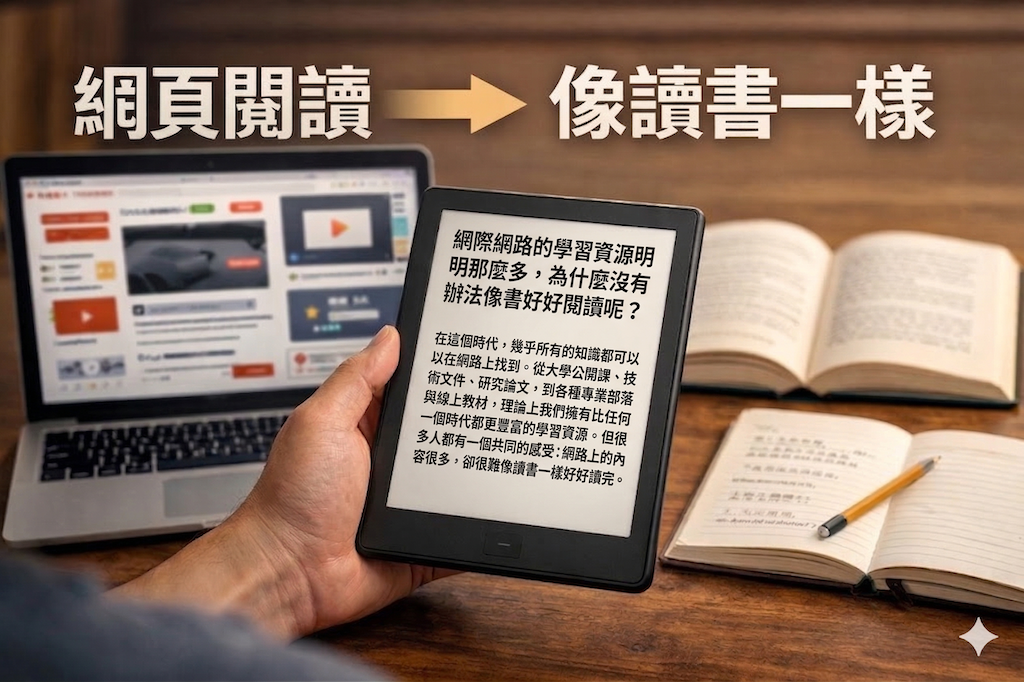
There is an incredible amount of knowledge online, but it’s surprisingly difficult to read it the way we read a book.
Why is that?
1. Webpages weren’t designed for deep reading
Most websites were never designed for long, focused reading sessions.
Their primary goals are usually things like:
- capturing attention
- increasing engagement
- maximizing time on site
As a result, webpages are filled with elements competing for your attention: sidebars, recommended articles, ads, notifications, pop-ups.
When you're trying to read an article, your attention is constantly pulled away.
A book, on the other hand, is extremely simple.
A page usually contains just a title, text, and maybe an illustration.
The reading experience is calm and continuous.
On the web, reading often becomes an experience of constant interruption.
2. Typography and layout are inconsistent
Books are carefully designed for readability.
Publishers spend a surprising amount of time thinking about details such as:
- line length
- line spacing
- paragraph spacing
- margins
- font choice
These details may seem small, but they have a huge impact on reading comfort.
Webpages rarely receive this level of typographic care.
Some articles have extremely wide lines.
Some use tight spacing that makes reading tiring.
Some use fonts that simply aren't pleasant for long reading sessions.
And because every website has its own design system, readers must constantly adapt to a new layout every time they visit a different site.
3. The concept of “pages” disappeared
Another subtle but important difference is the disappearance of pages.
In books, content is presented page by page.
Turning a page creates a natural reading rhythm.
It also helps readers remember roughly where information appeared.
Webpages, however, are typically designed as endless scrolling documents.
Reading becomes a process of continuously scrolling downward.
While scrolling feels convenient, it often makes it harder to build a clear mental structure of what you’ve read. Many people finish a long web article with only a vague memory of the content.
4. Our reading devices are full of distractions
The devices we use to read the web also contribute to the problem.
Most web reading happens on laptops or smartphones — devices that are constantly competing for our attention.
At any moment, there may be:
- multiple open tabs
- incoming notifications
- social media updates
- messaging apps
A single notification can break your concentration.
This is one reason why many people still prefer physical books or ebooks, even though the same information may exist online.
The format of books naturally supports focus.
The real problem isn’t the content
The issue is not that the internet lacks quality knowledge.
The real problem is that the web was never designed for deep reading.
But imagine if webpages could do a few things differently:
- remove unnecessary distractions
- provide consistent and comfortable typography
- allow content to be read page by page like a book while still preserving the interactive nature of the web
In that case, the knowledge on the internet might truly become a new kind of digital book.
Perhaps in the future, much of what we learn won’t come from traditional books at all.
It will come from the web.
But the reading experience could still feel as calm and focused as reading a book.
When that happens,
the internet might finally become the world’s largest library in practice — not just in theory.
What Eink Mode is trying to do
The idea behind Eink Mode is simple.
What if we could make reading the internet feel more like reading a book?
Instead of redesigning the entire web, Eink Mode focuses on transforming webpages into a format that is easier to read.
When Eink Mode is activated, a webpage is reorganized to:
- reduce distracting elements
- improve typography and layout
- make the content easier to focus on
- support a reading experience closer to an ebook
It’s not just about making pages cleaner
Eink Mode isn’t simply about removing elements from webpages.
The goal is to improve readability while preserving as much of the web’s interactivity as possible.
The future of knowledge will not consist of text alone.
It will include interactive charts, embedded videos, simulations, quizzes, and live demonstrations.
If these elements can coexist with a comfortable reading environment, the web could become a much more powerful learning platform.
Why E-Ink devices make this even more interesting
When this reading approach is combined with E-Ink devices, things become even more compelling.
E-Ink screens are particularly well suited for long reading sessions:
- they are easier on the eyes
- they produce little to no glare
- they consume very little power
- and they feel closer to reading real paper
When webpages can be formatted like books and viewed on E-Ink devices, the internet begins to offer something that has long been missing:
the ability to read the web like a book.
And perhaps in the future, what we read will no longer be limited to ebooks.
We may simply read the internet itself.